How to Measure Cooling Tower Fill for Replacement Orders
Ordering replacement cooling tower fill sounds simple until you discover that the old fill has no drawings, the original model is no longer available, or the dimensions do not match the supplier's standard sizes. This is a common situation in cooling tower maintenance and refurbishment projects.
If you are planning a cooling tower fill replacement, taking a few accurate measurements before requesting a quotation can save time, reduce installation problems, and help your supplier identify the right product. You do not always need a complete engineering drawing to get started. Clear dimensions, a few useful photographs, and some basic operating information are often enough for an initial assessment.
In this guide, we will walk through the key cooling tower fill replacement dimensions to measure, how to identify the existing fill structure, and what information to send a manufacturer before placing a bulk or OEM order.
Why Accurate Cooling Tower Fill Replacement Dimensions Matter
Cooling Tower Fill provides the contact surface where circulating water and air interact to transfer heat. If the replacement fill does not fit the existing tower properly, installation can become more difficult, and gaps or poor alignment may affect water distribution and airflow.
However, fitting into the available space is only part of the job. A replacement should also be compatible with the tower configuration, fill geometry, water quality, operating temperature, and required thermal performance.
Before ordering new Cooling Tower Media, check the following:
- Overall fill length, width, and height.
- Whether the tower uses counterflow or crossflow fill.
- Whether the existing media is film fill or splash fill.
- Corrugation pitch, flute angle, and sheet arrangement.
- Material, approximate sheet thickness, and visible condition.
- Support beam spacing and available installation space.
- Required quantity and any special cutting or assembly requirements.
These checks are especially useful for older towers, non-standard installations, and projects where the original manufacturer no longer supplies the same fill configuration.
Step 1: Measure the Length, Width, and Height of the Existing Fill
Start with the three basic dimensions. Use a tape measure or steel ruler, and record all measurements in millimeters or inches. For international orders, millimeters are often a convenient choice, provided every dimension uses the same unit.
1. Fill Length
Measure the overall length of one fill pack or the relevant fill section. If the fill consists of several connected blocks, record both the individual block length and the total installed length where possible.
Do not assume that every block in the tower has the same length. Some installations use different sections to fit around supports, piping, or the tower casing.
2. Fill Width
Measure the overall width of the fill pack, from one outside edge to the other. If multiple sheets are bonded or assembled together, check whether the quoted width refers to one sheet, one assembled module, or the complete fill block.
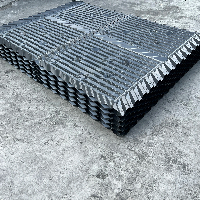
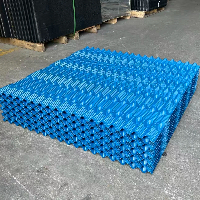
This distinction matters when ordering Corrugated Fill. A supplier may quote the width of an individual sheet, while your maintenance team may be measuring the complete assembled pack.
3. Fill Height or Depth
Measure the vertical height of the installed fill section, or the depth of the fill pack according to the tower layout. If the tower has two fill layers, record the height of each layer separately as well as the combined height.
For crossflow cooling towers, take care to distinguish the fill height from the horizontal depth of the fill bank. For counterflow towers, confirm the installed fill height and the direction in which the fill packs are stacked.
Practical tip: If the existing fill is heavily deformed or sagging, measure the available installation space and the original fill geometry separately where possible. Do not rely on the distorted dimensions alone.
Step 2: Identify the Cooling Tower Type and Fill Structure
Two fill packs can have similar outside dimensions but completely different internal structures. Before selecting a replacement, confirm whether your tower is a counterflow or crossflow design.
Counterflow Cooling Tower Fill
In a counterflow cooling tower, water generally moves downward while air travels upward through the fill. The fill arrangement must match the tower's airflow, water distribution system, and available installation space.
If your existing installation uses counterflow film fill, compare the dimensions and internal corrugation pattern with the proposed replacement. You can review our Counterflow Cooling Tower Fill options when checking the appropriate configuration for your project.
Crossflow Cooling Tower Fill
In a crossflow cooling tower, air moves horizontally through the fill while water flows downward. The fill dimensions, orientation, and relationship with the water distribution system are therefore important when planning a replacement.
Take a photograph showing the direction of the fill channels and the way the packs are installed. This is often more helpful than sending a close-up of the corrugated sheets alone.
Film Fill or Splash Fill?
Film Fill uses closely arranged corrugated sheets to spread water across a large surface area. Splash fill uses elements that repeatedly break up falling water into droplets.
If the existing tower uses film fill, record the sheet profile and spacing. If it uses splash fill, record the element arrangement and support configuration instead. Do not select a replacement based on outside dimensions alone.
Step 3: Measure Corrugation Pitch and Check Sheet Thickness
When ordering Film Fill or a film fill cooling tower product, the outside dimensions are only the starting point. The internal sheet geometry also needs to be checked.
What Is Cooling Tower Fill Pitch?
Pitch describes the spacing of the corrugation pattern. To avoid confusion, tell your supplier exactly how the measurement was taken. Depending on the product design, pitch may refer to the distance between corresponding points on adjacent corrugations.
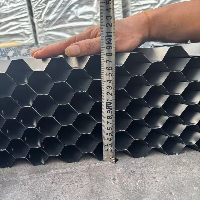
Use a ruler or caliper where appropriate, and take a clear close-up photograph with the measuring tool visible. If the old sheets are badly damaged, a loose section may be easier to measure than fill that remains installed.
Do not confuse corrugation pitch with the gap between assembled sheets. These are different measurements and should be recorded separately when both are relevant.
Check the Corrugation Angle
The corrugation angle affects the internal channel geometry and how air and water move through the fill. Photograph the side profile of a sheet so that the supplier can see the flute direction and approximate angle.
For replacement work, matching the existing profile is a useful starting point. Any proposed change in pitch, angle, or fill design should be checked against the tower's thermal and hydraulic requirements before production.
Check Sheet Thickness and Material
If possible, measure an undamaged, clean section of the sheet with a suitable thickness gauge or caliper. Record the approximate thickness and whether the measurement was taken before or after forming, if that information is known.
Also identify the material where possible:
- PVC: Commonly used for film fill in suitable commercial and industrial cooling applications.
- PP: Often considered for applications requiring different chemical or temperature resistance, depending on the material grade and operating conditions.
- CPVC: May be considered for applications requiring a different temperature or chemical resistance profile, subject to the manufacturer's specifications.
Appearance alone cannot reliably identify the polymer grade. If the original material is unknown, tell your supplier rather than guessing. The replacement material should be selected according to the actual operating conditions.
Step 4: Take the Right Photos Before Removing the Old Fill
Good photographs can prevent several rounds of questions between a maintenance contractor and a supplier. They are particularly useful when the original drawing is missing or the cooling tower has been modified over the years.
Before dismantling the old fill, take the following photographs where safe access is available:
- Full installation view: Show the complete fill section and its position inside the tower.
- Side view: Show the fill height, depth, and overall arrangement.
- Close-up of the corrugations: Capture the sheet profile, flute direction, and approximate pitch.
- Edge or end view: Show how the sheets are assembled or bonded.
- Support structure: Show the beams, supports, and available installation space.
- Damaged areas: Photograph cracking, deformation, scaling, or blocked passages.
- Measurement reference: Include a ruler or tape measure in the photograph wherever practical.
Try to take photos in good lighting and keep the camera square to the surface when measuring dimensions. A close-up that clearly shows the corrugation pattern is usually more useful than several distant photographs.
For safety, only inspect the tower after it has been shut down and isolated in accordance with the site's procedures. Do not enter operating equipment or climb into an unsafe tower just to obtain a measurement.
Step 5: Check the Support Structure and Installation Space
This step is easy to overlook. A new fill pack may have the correct nominal dimensions but still require modification if the support arrangement or available space is different from what was expected.
Before requesting a quotation, check:
- Distance between support beams.
- Available clearance around pipes, braces, and internal components.
- Number of fill layers and how they are stacked.
- Direction of installation and orientation of the fill channels.
- Whether the existing packs are glued, assembled, or installed as separate modules.
- Any damaged supports that may need attention before installation.
If the tower uses a non-standard layout, provide a simple hand-drawn sketch with the measurements marked. It does not need to look like a professional CAD drawing to be useful.
Step 6: Prepare a Cooling Tower Fill Replacement Specification Sheet
Once you have collected the measurements, put them into a simple specification sheet. This makes it easier to compare quotations and helps prevent misunderstandings when several people are involved in purchasing, engineering, and installation.
| Information | What to Provide |
|---|---|
| Tower configuration | Counterflow or crossflow |
| Fill type | Film fill or splash fill |
| Fill dimensions | Length × width × height or depth, with units |
| Corrugation pitch | Measured value, if available |
| Corrugation angle | Known angle or a profile photograph |
| Sheet thickness | Measured value and measurement method, if known |
| Material | PVC, PP, CPVC, or unknown |
| Quantity | Number of packs, required volume, or estimated quantity |
| Operating conditions | Hot-water temperature, water quality, and application |
| Installation details | Support spacing, stacking arrangement, and restrictions |
| Reference materials | Photos, drawings, existing part number, or tower model |
You do not need to know every specification before contacting a manufacturer. Provide what you have and mark unknown values clearly. The supplier can then identify which additional measurements are needed.
Common Mistakes When Measuring Cooling Tower Fill
Measuring Only the Outside Dimensions
Length, width, and height are essential, but they do not identify the fill profile, material, or operating suitability. Record the internal structure as well.
Confusing Individual Sheets With a Complete Fill Pack
Always clarify whether a dimension refers to one sheet, one bonded module, or the complete installed section. This is particularly important for custom and OEM orders.
Assuming Counterflow and Crossflow Fill Are Interchangeable
They are designed for different airflow arrangements. Confirm the tower configuration before selecting the replacement.
Ignoring the Existing Operating Conditions
A physically compatible fill may not be suitable for the actual water temperature, fouling conditions, or required cooling duty. Share the operating information whenever it is available.
Ordering From an Old Drawing Without Checking the Tower
Previous repairs and modifications may have changed the installation. Compare the drawing with the actual fill and support dimensions before approving production.
Which Cooling Tower Replacement Fill Should You Choose?
Once the measurements are available, the next step is to identify a suitable replacement product. The correct choice depends on the existing tower design, required dimensions, fill structure, material, and operating conditions.
For replacement projects, start by comparing the existing installation with the relevant product configuration rather than choosing a product based on its name alone.
If you are reviewing different film fill configurations, materials, or customized sizes, visit our Cooling Tower Replacement Fill page for more information about replacement applications.
For projects requiring customized dimensions or OEM supply, confirm the final specifications with the manufacturer before production. A suitable replacement should fit the tower structure and be appropriate for the intended operating conditions.
Frequently Asked Questions
What dimensions do I need to order cooling tower fill replacement?
Start with the fill length, width, and height or depth. Then record the tower configuration, fill type, corrugation pitch, sheet thickness, material, quantity, and support arrangement where possible. Clear photographs can help the supplier verify the configuration.
Can I order cooling tower replacement fill without the original drawings?
Yes, an initial assessment is often possible without original drawings. Provide accurate measurements, photographs of the installed fill and support structure, and any available tower model or part number. Additional information may be required before the final specification can be approved.
How do I identify film fill versus splash fill?
Film fill normally consists of closely arranged sheets with a corrugated surface. Splash fill uses elements designed to break up falling water. Take a close-up photograph of the structure and a wider photograph showing how it is installed if you are unsure.
Does cooling tower fill pitch affect replacement selection?
Yes. Corrugation pitch is one of the geometric characteristics that influence the internal fill channels. However, pitch alone does not determine cooling performance. The complete geometry, water distribution, airflow, pressure drop, and operating conditions should also be considered.
Can a manufacturer customize cooling tower fill dimensions?
Custom dimensions may be available depending on the product design and manufacturing requirements. When requesting an OEM quotation, provide the required dimensions, material, quantity, photographs, and any special assembly or packaging requirements. Confirm the final specifications before production begins.
What if I do not know the original fill material?
Do not identify the material based on color alone. Send photographs, any available product records, and the tower's operating conditions to your supplier. The appropriate replacement material should be confirmed based on the application and material specifications.
Ready to Request a Cooling Tower Fill Replacement Quote?
If you are sourcing cooling tower replacement fill for a maintenance project, refurbishment, or bulk purchasing program, start by gathering the measurements and photographs described above.
We manufacture cooling tower fill in Shenzhen, China, and support OEM requirements for suitable projects. You can send your existing fill dimensions, material preference, estimated quantity, and reference photographs for an initial review.
If some measurements are missing, that is fine. Explain what you know about the existing tower, and identify the details that still need to be confirmed. This gives us a practical starting point for discussing the required specifications.
Get a Cooling Tower Fill OEM Quote
Before placing an order, confirm the final dimensions, fill configuration, material, and application requirements with the supplier. Physical fit alone does not guarantee equivalent thermal performance.