OEM Cooling Tower Fill Manufacturer: What Should Buyers Look For?
OEM Cooling Tower Fill Manufacturer: What Should Buyers Look For?
When you are looking for an OEM Cooling Tower Fill supplier, the lowest price is usually not the first thing you should look at.
Cooling tower fill looks simple from the outside. It is basically formed plastic sheet assembled into blocks. But in actual cooling tower operation, small differences in raw material, sheet thickness, forming quality, pitch, bonding, and dimensions can affect installation, water distribution, pressure drop, service life, and overall cooling performance.
For cooling tower contractors, service companies, distributors, and original equipment manufacturers, choosing the right Cooling Tower Fill Manufacturer is therefore more about production capability and consistency than simply buying a standard product.
Here are the main things I would check before placing an OEM order.
1. Does the Manufacturer Really Understand Cooling Tower Fill?
This sounds obvious, but it is worth checking.
Some plastic processing companies can produce corrugated sheets, but that does not necessarily mean they understand how Cooling Tower Media works inside a cooling tower.
A manufacturer experienced in cooling tower fill should understand the difference between counterflow and crossflow applications, how pitch affects air and water contact, why sheet thickness matters, and how the fill geometry influences water distribution and heat transfer.
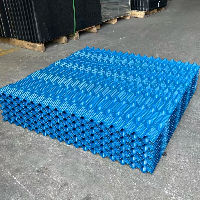
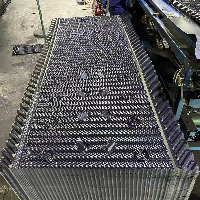
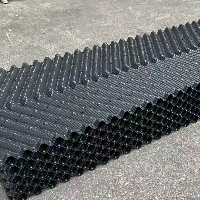
For example, a film fill cooling tower normally uses a structured surface to spread water into a thin film while air passes through the fill. The goal is to create enough contact area between air and water without creating unnecessary airflow resistance.
That is why a good OEM supplier should be able to discuss the application with you instead of simply asking, “What size do you need?”
Questions worth asking the manufacturer
- Is the fill designed for counterflow or crossflow cooling towers?
- What materials are available: PVC, CPVC, or PP?
- What pitch options are available?
- What sheet thicknesses can be produced consistently?
- Can the width and length be customized?
- Can the fill be supplied according to the customer's existing tower dimensions?
- Can the manufacturer support OEM packaging, labeling, and specifications?
If the supplier can answer these questions clearly, you are already having a much more useful conversation than simply comparing prices per cubic meter.
2. Raw Material Quality Is More Important Than It Looks
For Cooling Tower Fill, raw material quality directly affects the finished product.
This is particularly important for PVC film fill. A good-looking fill block can still have problems if the raw material has poor toughness, inconsistent formulation, or insufficient resistance to the operating environment.
During production, the plastic sheet needs to be formed without excessive cracking or deformation. During installation, the fill also needs enough toughness to handle cutting, assembly, transportation, and installation.
For some cooling tower applications, PP is preferred because of its higher temperature and chemical resistance compared with standard PVC. The correct material depends on the water chemistry, operating temperature, tower design, and customer requirements.
For buyers, I would recommend asking the supplier to clearly specify the material instead of accepting a general description such as “plastic cooling fill.”
PVC, CPVC, or PP?
There is no single material that is suitable for every cooling tower.
PVC Cooling Tower Fill is widely used because it offers a practical balance between cost, formability, and performance for many standard applications.
CPVC can be considered where higher temperature resistance is required.
PP cooling fill is often selected for applications involving higher operating temperatures or more demanding chemical conditions.
The important point is that material selection should be based on the actual operating environment rather than simply choosing the cheapest option.
3. Check the Fill Geometry and Pitch
Another common mistake is to treat all corrugated fill as the same.
It isn't.
The shape and pitch of the corrugation affect the way water spreads across the surface and how air moves through the fill. Different cooling tower designs may use different fill geometries.
For example, a Corrugated Fill with a smaller pitch can provide a high surface area, while a larger pitch may be more suitable where fouling, water quality, or airflow requirements need to be considered.
This is why replacement projects should not be based only on the outside dimensions of the old fill.
What should be confirmed before production?
- Fill width
- Fill length
- Sheet thickness
- Corrugation pitch
- Corrugation angle
- Counterflow or crossflow configuration
- Material
- Block connection method
- Installation orientation
These details help the manufacturer produce a replacement that actually fits the tower rather than simply producing a block with approximately the same dimensions.
4. Counterflow and Crossflow Fill Are Not Interchangeable
If you are buying tower fill for a replacement project, make sure the supplier knows whether the cooling tower is counterflow or crossflow.
In a counterflow cooling tower, air and water move in opposite directions through the fill. In a crossflow tower, air travels horizontally while water moves vertically through the fill.
The fill geometry and installation arrangement are therefore different.
This is one reason I recommend sending photos of the existing fill, measurements, and installation drawings to the OEM manufacturer before confirming an order.
If the original manufacturer's part number is available, send that as well. A good Cooling Tower Fill Manufacturer should be able to use this information to help confirm the replacement specification.
5. Manufacturing Consistency Matters More Than One Good Sample
This is something buyers sometimes overlook.
A supplier may send you a very good sample. The more important question is whether the next 500, 1,000, or 5,000 pieces will have the same quality.
For OEM customers, consistency is critical because the fill may be installed across multiple cooling towers or supplied under the customer's own brand.
Look at the manufacturer's production process, not only the finished sample.
Useful quality-control points include:
- Raw material inspection
- Sheet thickness control
- Forming temperature control
- Corrugation and pitch consistency
- Sheet bonding strength
- Block dimensions
- Visual inspection
- Packaging protection
Good production control also helps reduce problems such as warped fill, uneven sheets, weak bonding, broken edges, and dimensional differences between batches.
6. Can the Manufacturer Handle Real OEM Requirements?
There is a big difference between buying standard cooling fill and buying OEM Cooling Tower Fill.
An OEM customer may need a customized width, specific length, different pitch, special block arrangement, private labeling, customized packaging, or a particular connection method.
The supplier should be able to work from your drawings, samples, measurements, or technical specifications.
For example, if you are a cooling tower service company replacing damaged fill in an existing tower, you may not need a completely new tower design. You may simply need a reliable cooling tower replacement fill that matches the existing installation.
In that situation, flexibility is extremely useful.
7. Ask About Production Capacity Before You Need It
For a small trial order, almost any supplier may appear capable.
The real test comes when you need regular production.
If your company supplies cooling tower maintenance projects, seasonal demand can change quickly. A supplier that can produce a small quantity but struggles with repeat orders can become a problem later.
Before starting a long-term OEM relationship, ask about:
- Monthly production capacity
- Standard lead time
- Maximum customized dimensions
- Raw material availability
- Quality control process
- Packaging method
- Export experience
- Ability to handle repeat OEM orders
You don't necessarily need the biggest factory. You need a supplier whose production capacity matches your business.
8. Look at the Manufacturer's Product Range
A manufacturer producing several types of cooling fill can sometimes be easier to work with because the supplier understands different tower configurations and replacement requirements.
For example, an OEM supplier may provide high-efficiency film fill, counterflow fill, crossflow fill, PVC fill, PP fill, and other Cooling Fill products depending on the application.
Our product range includes High Efficiency Cooling Fill, which is designed for applications where efficient water-air contact and compact fill geometry are important.
For industrial projects, you can also review our Industrial Cooling Media System for a broader view of cooling media used in industrial cooling applications.
9. PP Cooling Fill Can Be a Useful Option for Demanding Applications
When operating temperature or chemical conditions become more demanding, PP is often worth discussing with the manufacturer.
PP has different temperature and chemical resistance characteristics from PVC, so it can be considered for applications where standard PVC fill may not be the preferred material.
Our PP Cooling Fill Module is one option for customers looking for PP-based cooling tower media.
Of course, material selection should always be checked against the actual cooling water temperature, water chemistry, tower operating conditions, and project requirements.
10. Don't Choose a Cooling Tower Fill Manufacturer Based Only on Price
Price is important. Nobody wants to overpay for cooling tower fill.
But the cheapest fill is not necessarily the lowest-cost solution.
If poor-quality fill needs to be replaced earlier than expected, or if the dimensions are inconsistent and installation takes longer, the actual project cost can quickly become higher.
For contractors and cooling tower service companies, there is another cost to consider: customer confidence.
If you install replacement fill and the customer has problems a few months later, the cost is not limited to the material itself.
That is why I would compare suppliers based on the complete package: material, dimensions, quality consistency, production capability, technical communication, lead time, packaging, and after-sales support.
11. What Information Should You Send to an OEM Supplier?
If you want a faster and more accurate quotation, don't just send a message saying, “Please quote cooling tower fill.”
Give the manufacturer enough information to understand the application.
A useful RFQ normally includes:
- Cooling tower type: counterflow or crossflow
- Existing fill dimensions
- Required quantity or total volume
- Material preference
- Pitch
- Sheet thickness, if known
- Operating water temperature
- Water quality or chemical conditions
- Photos of the existing fill
- Installation photos
- Drawings or original fill specifications
- Required delivery destination
Even if you don't have all of this information, send whatever you have. Photos and measurements are often enough for the manufacturer to start checking the specification.
12. A Simple OEM Cooling Tower Fill Buyer Checklist
Before placing an OEM order, I would personally check these points:
- Material: PVC, CPVC, or PP?
- Application: Counterflow or crossflow?
- Geometry: Is the pitch suitable for the application?
- Dimensions: Does the fill match the existing tower?
- Thickness: Is the sheet thickness controlled consistently?
- Bonding: Are the sheets firmly connected?
- Quality: Is there a documented inspection process?
- OEM: Can the supplier manufacture according to drawings or samples?
- Capacity: Can the supplier support repeat orders?
- Export: Does the supplier understand overseas packaging and shipping?
What Makes a Good Cooling Tower Fill Manufacturer?
In my experience, a reliable Cooling Tower Fill Manufacturer is not simply the company offering the lowest quotation.
You want a supplier that understands the application, controls the raw material and forming process, can maintain consistent dimensions, and is willing to discuss the technical details before production.
For OEM buyers, that combination becomes even more important because your reputation may depend on the quality of the fill you supply to your customer.
Whether you need Film Fill for a new cooling tower, Corrugated Fill for an industrial application, or cooling tower replacement fill for an existing tower, the right manufacturer should be able to help you confirm the specification before you place the order.
Looking for OEM Cooling Tower Fill?
We manufacture cooling tower fill in Shenzhen, China and support OEM requirements for different cooling tower applications.
If you already have dimensions, drawings, photos, samples, or an existing fill specification, send them to us. We can review the application and discuss the suitable material, fill geometry, dimensions, and production requirements.
Get a Cooling Tower Fill OEM Quote