Cooling Tower Fill for Industrial Cooling Applications
Cooling Tower Fill for Industrial Cooling Applications
In an industrial cooling system, the cooling tower fill is one of those components that is easy to overlook until something goes wrong. When the fill becomes damaged, blocked, deformed, or simply no longer performs as it should, the cooling tower can lose a noticeable amount of heat transfer efficiency.
For factories, power plants, chemical plants, and other industrial facilities, choosing the right Cooling tower Fill is not simply a matter of buying the same size as the old fill. Water quality, operating temperature, tower design, airflow, material compatibility, and the way the fill is installed all matter.
In this guide, we will look at the practical points engineers usually consider when selecting tower fill for an industrial cooling system, including film fill, corrugated fill, counterflow and crossflow applications, as well as PVC and PP options.
Why Cooling Tower Fill Matters in Industrial Cooling Systems
The main job of cooling tower fill is to increase the contact area between hot circulating water and the air moving through the tower.
Instead of allowing water to fall directly through the tower, the fill spreads the water into thin films or droplets over a large surface area. This gives the air more opportunity to remove heat from the water.
That sounds simple, but in a large industrial cooling tower, a relatively small change in fill performance can affect the entire cooling system.
When the fill is working properly, it helps provide:
- Better water distribution and air-water contact
- More effective heat transfer
- Stable cooling water temperature
- Good airflow through the fill pack
- Reliable operation under continuous industrial conditions
On the other hand, damaged or poorly manufactured fill can create uneven water distribution, restricted airflow, deformation, excessive fouling, and reduced cooling performance.
Where Industrial Cooling Tower Fill Is Commonly Used
Industrial cooling towers operate under very different conditions depending on the application. A fill solution that works well for an HVAC cooling tower may not necessarily be the best choice for a chemical plant or power station.
Cooling Tower Fill for Factories
Factories often use cooling towers for process cooling, machinery cooling, compressors, injection molding equipment, furnaces, heat exchangers, and other production equipment.
In these systems, stable cooling water temperature is usually more important than simply achieving the lowest possible initial cost. The fill needs to maintain its shape and heat transfer surface during long operating periods.
Cooling Tower Fill for Power Plants
Power plants can have very large circulating water flows and long operating hours. Cooling tower fill therefore needs to handle continuous water circulation while maintaining good airflow and heat transfer.
For replacement projects, engineers normally need to check the existing fill dimensions, pitch, material, support structure, water distribution, and airflow direction before selecting a replacement.
Cooling Tower Fill for Chemical Plants
Chemical plants can be more demanding because circulating water may contain chemicals, dissolved solids, or contaminants that can affect the fill material.
In these applications, material selection becomes particularly important. PVC, CPVC, and PP may be considered depending on the actual water chemistry and operating temperature.
Film Fill or Splash Fill: Which One Is Better?
For many industrial cooling towers, film fill is selected because it provides a large effective surface area within a relatively compact volume.
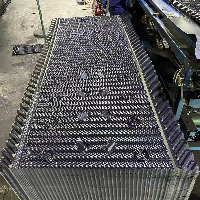
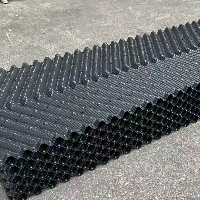
A film fill cooling tower uses closely spaced sheets with a formed surface. As water flows down the sheets, it spreads into a thin film while air passes through the fill pack.
This creates a large contact area between water and air, which is why film fill is widely used in modern cooling towers.
However, film fill is not automatically the best choice for every application. If the circulating water contains a high level of suspended solids, biological growth, or other contaminants, the narrow passages between the sheets can become fouled.
For this reason, water quality should always be considered before changing from one fill type to another.
How Corrugated Fill Improves Water-Air Contact
Corrugated Fill is commonly used to create a longer and more effective path for water and air inside the cooling tower.
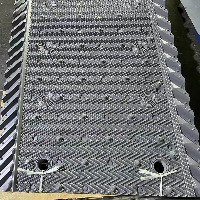
The corrugated surface helps distribute water over the fill sheets while creating turbulence and increasing contact between the water and airflow.
In practical terms, a good corrugated fill should do three things well:
- Spread the circulating water evenly.
- Maintain enough surface area for heat transfer.
- Allow air to pass through the fill without excessive pressure drop.
The exact sheet design, pitch, thickness, and forming pattern can be selected according to the cooling tower design and operating conditions.
Counterflow vs. Crossflow Cooling Tower Fill
Before ordering replacement fill, one of the first things to confirm is whether the cooling tower is a counterflow or crossflow design.
Counterflow Cooling Tower Fill
In a counterflow tower, air generally moves upward while water flows downward through the fill.
This arrangement allows the water and air to move in opposite directions, which provides effective heat transfer within a relatively compact tower design.
For counterflow applications, the fill geometry, pitch, height, and installation method need to match the tower's water distribution and airflow conditions.
If you are replacing existing fill in a counterflow tower, see our Counterflow Cooling Tower Fill for available configurations.
Crossflow Cooling Tower Fill
In a crossflow cooling tower, air normally moves horizontally across the falling water.
The construction and fill arrangement are therefore different from a counterflow tower. Using the wrong fill geometry can affect water distribution, airflow, and overall cooling performance.
For replacement work, it is better to measure the existing fill and confirm the tower configuration before ordering.
For more information, see our Crossflow Cooling Tower Fill page.
PVC or PP Cooling Tower Fill?
Material selection is another important decision, especially for industrial applications.
PVC Cooling Tower Fill
PVC is widely used for cooling tower film fill because it provides a practical balance between cost, forming performance, mechanical strength, and operating temperature.
For many standard industrial cooling applications, PVC cooling tower fill can be a reliable and economical choice.
However, the actual operating temperature and water chemistry should always be checked before selecting PVC.
PP Cooling Tower Fill
PP can be considered when the operating conditions require a different material solution, particularly where higher temperature resistance or specific chemical compatibility is important.
The correct material depends on the actual operating conditions rather than simply choosing the most expensive option.
For industrial projects where PP is preferred, you can also review our PP Cooling Fill Module.
What Should You Check Before Replacing Cooling Tower Fill?
This is where many replacement projects go wrong. It is tempting to measure only the width and length of the old fill and order a similar-looking product.
In practice, there are several more details worth checking.
1. Fill Width and Length
Measure the existing fill pack carefully. The replacement does not necessarily need to have exactly the same individual sheet dimensions, but it must fit the existing tower structure and support arrangement.
2. Fill Pitch
The pitch determines the spacing between the formed sheets. A smaller pitch can provide more surface area, but it may also be more sensitive to fouling when water quality is poor.
For industrial cooling towers, the pitch should be selected according to the cooling requirement and water condition rather than treated as a simple standard dimension.
3. Material
Confirm whether the existing fill is PVC, CPVC, PP, or another material. Also check the circulating water temperature and chemical conditions.
4. Counterflow or Crossflow
Do not assume that all cooling tower fill is interchangeable. Counterflow and crossflow towers have different airflow and water distribution arrangements.
5. Fill Condition
During inspection, look for brittle sheets, cracks, deformation, broken bonding points, excessive scaling, algae, and blocked passages.
If the fill sheets can be easily torn by hand or have become noticeably brittle, this may indicate material aging or poor-quality raw material. In that situation, replacing only the visibly damaged sections may not solve the long-term problem.
Common Problems Caused by Poor Quality Tower Fill
Not all cooling tower fill looks the same. Two products may have similar dimensions but behave very differently after months or years of operation.
Uneven Sheet Thickness
If the raw material is not processed consistently, the finished sheets may have uneven thickness. Thin areas can become weak and may deform or tear more easily.
Poor Bonding
For assembled fill packs, weak bonding can cause the structure to become loose during transportation, installation, or long-term operation.
Deformation
When the material cannot withstand the actual operating temperature and water conditions, the formed sheets may gradually deform. Once the original geometry changes, water distribution and airflow can also be affected.
Short Service Life
A low-cost fill is not necessarily a low-cost solution if it needs to be replaced frequently. For industrial cooling systems, material consistency and mechanical strength are often more important than saving a small amount on the initial purchase price.
Cooling Tower Fill Replacement: A Practical Approach
When an existing cooling tower is still structurally sound but the fill has reached the end of its service life, a cooling tower replacement fill project can often be a practical way to restore cooling performance without replacing the entire tower.
Before ordering, it is useful to prepare a few basic details:
- Cooling tower type: counterflow or crossflow
- Existing fill dimensions
- Fill pitch
- Material currently being used
- Circulating water temperature
- Water quality and chemical conditions
- Approximate fill volume
- Photos of the existing fill and support structure
Photos are especially useful when the original fill specification is unavailable. An experienced supplier can often identify the general fill configuration from the dimensions, forming pattern, and installation method.
If you are planning a replacement project, you can also review our Cooling Tower Replacement Fill options.
How to Choose the Right Cooling Tower Media for an Industrial Project
There is no single Cooling Tower Media that is perfect for every industrial cooling system.
A better approach is to start with the operating conditions and work backwards.
For example, if you have a standard industrial cooling application with relatively clean circulating water, PVC film fill may be a practical starting point. If temperature or chemical conditions are more demanding, PP or other material options may need to be considered.
Likewise, if the project is a replacement rather than a new tower, matching the existing tower's airflow direction, fill dimensions, support structure, and water distribution system may be more important than simply choosing a high-performance fill on paper.
In other words, the best Cooling Fill is the one that matches the whole cooling tower system, not just the product specification sheet.
Need a Custom Cooling Tower Fill?
For industrial cooling projects, standard sizes do not always fit the existing tower. Width, length, pitch, material, bonding method, and packing configuration can often be adjusted according to the project requirements.
We manufacture cooling tower fill in Shenzhen, China and support OEM requirements for different cooling tower designs and replacement projects.
If you have the old fill dimensions, a drawing, or simply a few photos of the existing fill, send them over. We can check the configuration with you before you place an order.
Get a Cooling Tower Fill OEM Quote
Frequently Asked Questions About Industrial Cooling Tower Fill
How often should industrial cooling tower fill be replaced?
There is no fixed replacement interval for every cooling tower. Service life depends on water quality, operating temperature, chemical exposure, UV exposure, cleaning practices, and the quality of the fill material.
Can PVC cooling tower fill be replaced with PP?
It can be possible, but the operating temperature, chemical conditions, tower design, and installation dimensions should be checked first. Material substitution should not be based on dimensions alone.
Can counterflow fill be used in a crossflow cooling tower?
Generally, cooling tower fill should be selected according to the tower's airflow and water distribution design. Counterflow and crossflow fill arrangements are not automatically interchangeable.
What information do I need to request replacement fill?
At minimum, provide the tower type, fill dimensions, pitch, material if known, approximate quantity, and operating conditions. Photos of the existing fill are also very helpful.