Cooling Tower Fill for HVAC Systems: Selection Guide
If you work on HVAC cooling towers, you already know that choosing the right cooling tower fill is not as simple as finding a sheet of PVC and putting it inside the tower.
When a cooling tower starts losing performance, contractors are often asked to solve the problem quickly. The customer may complain that the condenser water temperature is too high, the tower is not performing like it used to, or the existing fill is cracked, dirty, or badly deformed.
In many cases, the fill is part of the problem. But replacing it with the wrong type can create another problem.
This guide explains how HVAC contractors can select the right Cooling Tower Fill based on tower type, water quality, dimensions, operating conditions, and the actual replacement job.
Why Cooling Tower Fill Matters in HVAC Systems
The main job of cooling tower fill is to increase the contact area between hot water and air.
Water flows over the surface of the fill while air moves through the tower. The more effectively these two streams contact each other, the more heat can be transferred from the circulating water to the air.
That is why the condition and design of the tower fill can have a noticeable effect on cooling tower performance.
For HVAC applications, the most common types are film fill and splash fill. Modern mechanical-draft cooling towers commonly use Film Fill because it provides a large wetted surface area in a relatively compact space.
However, the highest-efficiency fill is not automatically the best choice for every project. Water quality, temperature, fouling, tower design, and maintenance conditions all matter.
Film Fill vs. Other Cooling Tower Media
For most HVAC cooling towers, film fill cooling tower designs are a practical starting point when the circulating water is reasonably clean.
Film fill works by spreading water into a thin film over a large surface area. This creates a good air-water contact area without requiring a large amount of fill volume.
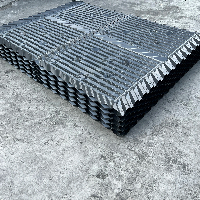
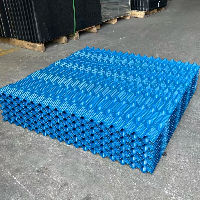
A typical Corrugated Fill has a structured surface that helps distribute water and creates a longer contact path between air and water.
Compared with traditional splash-type Cooling Tower Media, film fill can provide higher heat-transfer efficiency when the water quality and operating conditions are suitable.
But there is an important point contractors should keep in mind: higher efficiency does not mean “suitable for every tower.”
If the circulating water contains a lot of suspended solids, biological growth, oil, or other contaminants, a very fine film-fill design may foul faster than expected.
5 Things HVAC Contractors Should Check Before Selecting Cooling Tower Fill
1. Identify the Cooling Tower Type
Start with the tower itself.
Is it a counterflow cooling tower or a crossflow cooling tower?
This matters because the airflow and water distribution arrangement are different. The fill geometry, installation method, width, angle, and module arrangement may also be different.
Do not select replacement fill based only on the old fill's appearance. Two products can look similar but perform differently once installed in the tower.
Before ordering, check:
- Counterflow or crossflow design
- Original fill arrangement
- Fill width and length
- Fill thickness
- Flute or pitch
- Installation direction
- Existing support structure
2. Measure the Existing Fill Carefully
This is one of the most common mistakes during a cooling tower replacement project.
Contractors sometimes measure only the overall tower dimensions. That is not enough.
The replacement fill should be measured from the actual fill blocks or sheets whenever possible.
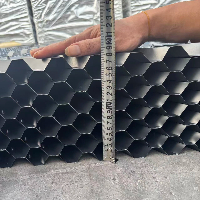
For example, record:
- Module width
- Module height
- Module length
- Number of blocks
- Pitch or flute spacing
- Fill angle
- Connection method
If the original fill is badly damaged, take several measurements from different sections. Old PVC fill can shrink, deform, or become brittle after years of operation.
For a contractor, accurate measurements before ordering can save a lot of trouble during installation.
3. Check the Water Quality
This is probably the most important point after tower dimensions.
A cooling tower operating with relatively clean HVAC condenser water has different requirements from a tower handling dirty industrial water.
Check for:
- Suspended solids
- Hardness and scaling tendency
- Biological growth
- Oil contamination
- High chemical concentration
- Operating temperature
If the water is dirty, the contractor should consider whether the selected Cooling Fill can tolerate the expected fouling conditions.
There is no benefit in installing a high-efficiency fill if it becomes heavily blocked a few months later.
4. Choose the Right Material
PVC is widely used for HVAC cooling tower fill because it offers a practical combination of cost, processability, and resistance to normal cooling tower operating conditions.
For more demanding temperature or chemical environments, CPVC or PP may be considered depending on the application.
The material should be selected based on the actual operating temperature and water chemistry rather than simply choosing the most expensive option.
For standard HVAC applications, PVC Cooling Tower Fill is often a sensible starting point.
5. Think About Installation, Not Just Heat Transfer
A fill block that looks good on a datasheet can still be inconvenient to install.
For replacement projects, installation time matters. Contractors usually have a limited shutdown window, and the customer wants the cooling tower back in operation as quickly as possible.
Before ordering cooling tower replacement fill, confirm how the modules will be connected and supported.
Depending on the tower design, fill modules may use glue, hanging arrangements, support grids, or other installation methods.
If you are replacing an existing system, matching the original installation arrangement can often make the job much easier.
How to Choose the Right Film Fill Cooling Tower Design
When selecting Film Fill, do not focus on pitch alone.
Pitch is important because it affects the size of the water and air passages. A smaller pitch can provide a larger surface area, but it may also be more sensitive to fouling.
A larger pitch can provide better passage space for water and debris, depending on the application.
The right choice is therefore a balance between heat-transfer requirements, water quality, airflow, pressure drop, and maintenance conditions.
For HVAC contractors, a practical selection process is:
- Identify the tower type.
- Measure the existing fill.
- Check operating water temperature.
- Review water quality and treatment.
- Determine whether the tower needs high-efficiency film fill.
- Confirm module dimensions and installation method.
- Check whether the replacement fill fits the existing support structure.
PVC Cooling Tower Fill for HVAC Replacement Projects
For many HVAC cooling tower replacement jobs, PVC remains one of the most practical choices.
It is widely used for film-fill applications where the operating conditions are within the normal range for PVC.
If you already know the tower dimensions and need to compare different PVC fill configurations, you can see our PVC Cooling Tower Fill options here.
When discussing a replacement project, it is helpful to send the supplier the existing fill dimensions, tower type, operating temperature, and photos of the current installation. This allows the fill manufacturer to recommend a more suitable configuration instead of simply quoting a generic product.
When Should HVAC Contractors Replace Cooling Tower Fill?
There is no single replacement interval that applies to every cooling tower.
Instead of replacing fill simply because it has been in service for a certain number of years, look at its actual condition.
Typical warning signs include:
- Cracked or brittle PVC sheets
- Collapsed or deformed fill blocks
- Heavy scaling
- Biological fouling
- Blocked air passages
- Poor water distribution
- Increasing condenser water temperature
- Visible pieces of fill falling into the basin
If several of these problems appear at the same time, a cooling tower replacement fill project may be more practical than continuing to repair individual sections.
Don't Replace Good Fill With the Wrong Fill
One thing we have seen repeatedly in cooling tower projects is that contractors sometimes order replacement fill by simply saying, “I need the same size as the old one.”
That is a good starting point, but it is not always enough.
The original fill may no longer be available. The tower may have been modified. The operating conditions may have changed. Or the original fill may have been selected poorly in the first place.
For this reason, a replacement project should be treated as a small engineering check rather than just a spare-parts purchase.
If you can provide the original fill dimensions, tower type, water temperature, airflow direction, and a few photos, the manufacturer can usually determine much more accurately which tower fill configuration makes sense.
Cooling Tower Fill Selection Checklist for HVAC Contractors
Before placing an order, use this quick checklist:
| Item | What to Check |
|---|---|
| Tower type | Counterflow or crossflow |
| Fill type | Film fill, splash fill, or existing configuration |
| Material | PVC, CPVC, PP, etc. |
| Dimensions | Width, length, height |
| Pitch | Existing flute/pitch specification |
| Operating temperature | Actual circulating water temperature |
| Water quality | Scale, solids, biological growth, oil, chemicals |
| Installation | Glue, hanging, support grid, or other method |
| Replacement quantity | Number of modules or total fill volume |
Cooling Tower Media: What Should You Send Your Fill Supplier?
If you are an HVAC contractor requesting a quotation, you don't need to prepare a complicated engineering report.
Usually, the following information is enough to start:
- Cooling tower manufacturer and model, if available
- Counterflow or crossflow
- Existing fill dimensions
- Photos of the existing fill
- Water inlet and outlet temperature
- Approximate circulating water flow
- Operating water quality
- Required quantity
With this information, a fill manufacturer can check whether the existing configuration can be reproduced or whether another Cooling Tower Media design would be more appropriate.
Final Advice: Start With the Tower, Not the Product Catalog
When selecting cooling tower fill for an HVAC system, it is tempting to start by comparing product names, prices, or heat-transfer claims.
In real replacement work, it is usually better to start with the tower.
Understand the airflow direction. Measure the existing fill. Check the water quality. Look at the operating temperature. Then choose the fill design.
That approach usually leads to a much better result than simply choosing the highest-efficiency Film Fill available.
If you are replacing old or damaged fill and already have the tower dimensions, our Cooling Tower Fill Media page is a good place to compare available configurations.
Frequently Asked Questions
What type of cooling tower fill is commonly used in HVAC systems?
Film fill is commonly used in many HVAC cooling towers because it provides a large surface area for air-water contact. The actual selection should still consider tower type, water quality, operating temperature, and fouling conditions.
Is PVC cooling tower fill suitable for HVAC applications?
Yes. PVC is widely used for HVAC cooling tower fill when the operating temperature and water chemistry are suitable for PVC. For higher-temperature or more chemically demanding applications, other materials may be considered.
How do I know if I need cooling tower replacement fill?
Look for cracked, brittle, collapsed, heavily scaled, or blocked fill. Poor cooling performance and deteriorating water distribution can also indicate that the existing fill needs inspection or replacement.
Can replacement cooling tower fill be customized?
Yes. Cooling tower fill can often be customized according to the required width, length, pitch, material, and installation arrangement. Providing the existing fill dimensions and photos is helpful when requesting a replacement quotation.
Can I use the same fill for counterflow and crossflow cooling towers?
Not necessarily. Counterflow and crossflow towers have different airflow and water distribution arrangements, so the fill configuration should be selected according to the tower design.
Need Help Selecting Cooling Tower Fill?
If you are an HVAC contractor and already have an upcoming cooling tower replacement project, send us the fill dimensions, tower type, operating temperature, quantity, and a few photos of the existing installation.
We can check the configuration and provide a suitable OEM solution for your project.
```