Common Problems Caused by Poor Quality Cooling Tower Fill
Common Problems Caused by Poor Quality Cooling Tower Fill
When a cooling tower starts losing performance, most people will check the fan, water flow, spray nozzles, or pump first.
That makes sense. But there is one part that is often overlooked: the Cooling Tower Fill.
The fill is where the water spreads out and comes into contact with the air. If the fill is poorly manufactured, incorrectly installed, or made from unsuitable material, the cooling tower may gradually lose efficiency even though the rest of the system appears to be working normally.
In real cooling tower maintenance projects, some problems are surprisingly simple to trace back to the fill itself.
Here are several common problems we recommend checking before deciding that the cooling tower needs a major modification.
1. Uneven Thickness in the Fill Sheet
One of the first things to look at is the thickness of the plastic sheet.
A good film fill cooling tower needs consistent material thickness and forming quality. If one area of the sheet is noticeably thinner than another, the finished fill can have weaker sections and less consistent channel geometry.
This may not cause an immediate failure. In fact, a new fill can look perfectly acceptable during the first inspection.
The problem usually appears later.
Thin areas can become more vulnerable to deformation, cracking, or damage during cleaning and long-term operation. At the same time, inconsistent forming can change the shape of the water and air channels.
That can affect:
- Water distribution across the fill surface
- Airflow through the fill pack
- Effective heat transfer area
- Mechanical strength of the fill
- Expected service life
Thickness is not the only factor that determines fill quality, but large variations are certainly something worth paying attention to.
2. Poor Bonding Between Fill Sheets
Another problem we sometimes see is poor bonding.
Many types of Cooling Tower Media are assembled by bonding individual sheets together. The bonding points need to remain stable while the fill is exposed to continuous water flow, vibration, temperature changes, and routine maintenance.
If the bonding is weak, the fill sheets can gradually separate.
Once the sheets start moving, the original channel structure may change. Some sections can become compressed, while other sections may open up too much.
This affects the way air and water move through the tower.
It is also worth remembering that a bonding problem may not be obvious when the fill is first installed. It can develop after months or years of operation.
For this reason, when inspecting an existing Film Fill, check the bonding points as well as the plastic sheet itself.
3. Deformation Can Change Cooling Tower Performance
Deformation is one of the easiest fill problems to understand, but it can have a surprisingly large effect on performance.
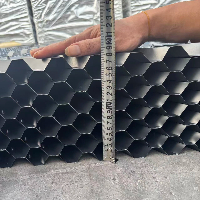
Every Corrugated Fill has a designed shape, pitch, angle, and channel structure. These dimensions determine how water spreads over the surface and how air passes through the fill pack.
When the fill becomes deformed, those carefully designed channels can change.
For example, a section of fill may become compressed and restrict airflow. Another section may bend and create an uneven water path.
The result can be:
- Higher air resistance
- Uneven water distribution
- Reduced effective contact area
- Lower cooling performance
- More difficult maintenance
Deformation can be caused by several things, including excessive operating temperature, unsuitable material, poor manufacturing quality, incorrect support, chemical attack, or simply long-term aging.
So if an old tower fill looks noticeably different from its original shape, don't ignore it.
4. Short Lifetime Can Become an Expensive Problem
Low-cost fill can be tempting when you are comparing quotations.
But the purchase price is only one part of the cost.
If poor-quality fill needs to be replaced much earlier than expected, you may end up paying for the same job twice.
A second cooling tower replacement fill project means additional costs for material, labor, shutdown time, cleaning, removal of the old fill, transportation, and installation.
For an industrial cooling tower, downtime can be much more expensive than the fill itself.
That is why we normally recommend looking at the expected service life and operating conditions instead of comparing suppliers only by price.
5. Poor Fill Can Increase Air Resistance
Here is another problem that is easy to miss because you cannot always see it from outside the tower.
The geometry of the fill channels affects how easily air can move through the fill.
If the channels are inconsistent, partially blocked, badly deformed, or incorrectly assembled, the pressure drop can increase.
When that happens, the fan may need to work harder to maintain the required airflow.
In a small cooling tower, the difference may not be significant. In a large industrial system operating continuously, however, additional fan energy can become a meaningful operating cost.
This is why a good tower fill should be evaluated for both heat transfer performance and airflow resistance.
6. Material Selection Matters More Than Many People Think
Not every cooling tower operates under the same conditions.
Water chemistry, operating temperature, contamination, cleaning methods, and the type of cooling process can all affect the service life of the fill.
PVC is commonly used for many cooling tower applications because it offers a practical combination of cost, processability, and chemical resistance.
PP may be a better choice for some applications where higher temperature or specific chemical conditions need to be considered.
In more demanding environments, CPVC may also be considered.
So when selecting Cooling Fill, the question should not simply be:
“Which material is cheapest?”
A better question is:
“Which material is suitable for the actual operating conditions of this cooling tower?”
7. Fouling and Clogging Can Make Good Fill Perform Badly
Not every cooling problem means that the fill itself was manufactured poorly.
Sometimes a good-quality fill simply becomes heavily fouled after years of operation.
Dirt, algae, scale, suspended solids, and other deposits can build up on the fill surface and inside the channels.
Once the channels become restricted, water distribution and airflow can both be affected.
This is why inspection should separate two different problems:
- Fill quality problems – such as uneven thickness, poor bonding, or weak material.
- Operating and maintenance problems – such as fouling, scaling, and poor water treatment.
Understanding the difference can save a lot of unnecessary troubleshooting.
8. How to Check Cooling Tower Fill During an Inspection
You don't always need sophisticated equipment to identify obvious fill problems.
A basic visual inspection can tell you quite a lot.
Check the Sheet Condition
Look for cracks, brittle areas, unusual discoloration, thinning, or obvious differences in sheet thickness.
Check the Fill Geometry
Look at the pitch, channels, angle, and overall shape of the fill. Compare several sections rather than checking only one module.
Check the Bonding
Look for separated sheets, loose sections, and weak bonding points. If the fill moves easily by hand, further inspection may be necessary.
Check for Deformation
Pay particular attention to areas close to hot-water inlets or locations where the fill is supported incorrectly.
Compare Cooling Performance
Finally, compare current operating data with previous results whenever possible. If the cooling approach has changed significantly while water flow, fan operation, and other major conditions remain similar, the fill should be included in the investigation.
9. When Should You Replace the Cooling Tower Fill?
There is no single replacement schedule that works for every cooling tower.
The actual service life depends on the fill material, water quality, operating temperature, chemical conditions, maintenance, and tower design.
However, replacement is worth considering when you see several of the following signs:
- The fill is badly deformed
- Sheets are cracking or becoming brittle
- Bonding points are failing
- Channels are heavily blocked
- Water distribution has become uneven
- Cooling performance has dropped
- The fill has reached the end of its expected service life
If several of these problems appear at the same time, repairing individual sections may not be the most economical solution.
In many cases, replacing the entire fill pack with a properly selected cooling tower replacement fill is a more practical approach.
10. Choosing the Right Replacement Fill
Before ordering a replacement, don't rely only on a photograph of the old fill.
Photos are useful, but dimensions and operating conditions are much more helpful.
Try to confirm:
- Cooling tower type: counterflow or crossflow
- Fill width and length
- Pitch
- Angle
- Material
- Connection or bonding method
- Operating water temperature
- Water quality and chemical conditions
If you are replacing an existing PVC fill, you can review our PVC Cooling Tower Fill page for more information.
For projects where the existing fill needs to be replaced, our Cooling Tower Replacement Fill page is also a useful starting point.
11. A Good Fill Supplier Should Ask Questions
This is something we think is important.
If you contact a fill supplier and they immediately give you a price after asking only the quantity, be careful.
A proper replacement depends on more than quantity.
An experienced supplier should normally ask about the cooling tower type, existing fill dimensions, material, operating temperature, water conditions, and application.
Sometimes the customer only needs the same size as the old fill. In other projects, changing the material or fill configuration may be worth considering.
The right answer depends on the actual cooling tower.
12. Final Thoughts
Poor-quality Cooling Tower Fill does not always fail suddenly.
More often, the problems develop slowly: the sheets become weaker, bonding starts to fail, the fill deforms, channels become restricted, and cooling performance gradually drops.
That is why fill quality matters from the beginning.
A well-made film fill cooling tower or Corrugated Fill should maintain its designed shape, provide a stable water distribution surface, and remain mechanically strong under the expected operating conditions.
When replacing old fill, don't simply look for the lowest price. Look at the material, dimensions, manufacturing quality, application, and expected service life together.
Related Cooling Tower Fill Products
If you are comparing options for a cooling tower maintenance or replacement project, the following pages may be useful:
Need a Cooling Tower Fill Replacement?
If you are dealing with damaged, deformed, brittle, or poor-quality cooling tower fill, send us the existing fill dimensions, photos, material requirements, and cooling tower type.
We can help check the configuration and recommend a suitable replacement option for your project.
```