How to Improve Cooling Tower Efficiency by Replacing Old Fill
How to Improve Cooling Tower Efficiency by Replacing Old Fill
If a cooling tower is running but the water temperature is not coming down as it used to, the problem is not always the fan, pump, or motor.
Sometimes, the real problem is much simpler: the cooling tower fill is old.
Cooling tower fill has a direct impact on how much contact the hot water gets with the air inside the tower. When the fill becomes dirty, brittle, deformed, or damaged, the tower can gradually lose cooling performance.
This is why replacing old Cooling Tower Fill can sometimes improve tower performance without replacing the entire cooling tower.
Why Old Cooling Tower Fill Reduces Cooling Performance
New cooling tower fill is designed to spread water into a thin and relatively uniform film. This gives the air and water more contact area, which helps heat transfer and evaporation.
After years of operation, however, the fill can start to change.
1. Dirt and Scale Build Up on the Fill
Dust, algae, mineral deposits, oil, and other contaminants can gradually build up on the surface of the fill.
When this happens, water may no longer spread evenly across the surface. Some areas can become blocked while other areas receive too much water.
The result is less effective air-water contact and lower cooling performance.
2. The Fill Can Become Brittle
PVC is commonly used for film fill cooling tower applications because it offers a good balance between cost, chemical resistance, and operating temperature.
But after years of exposure to heat, UV, chemicals, and continuous operation, PVC fill can become brittle.
Once the sheets start cracking or breaking, the original geometry of the Film Fill is no longer maintained.
3. Deformed Fill Changes the Air and Water Flow
The shape of the fill is not just for appearance. Corrugations, channels, spacing, and pitch are designed to control how water flows over the surface and how air moves through the fill pack.
If old Corrugated Fill becomes crushed or deformed, the air passages can become restricted.
That means the fan may still be working normally, but the cooling tower is not getting the same performance from the available airflow.
Signs That Your Cooling Tower Fill May Need Replacement
You do not always need laboratory testing to identify an aging tower fill. In many cases, the operating symptoms are already giving you clues.
- Cold water temperature is higher than it used to be.
- The tower requires more airflow to achieve the same cooling result.
- Water is not spreading evenly across the fill.
- Fill sheets are cracked, brittle, sagging, or deformed.
- Large amounts of scale or biological growth are visible.
- Some areas of the fill pack are blocked.
- The cooling tower has been operating for many years without a fill replacement.
- Cleaning the fill no longer restores the original cooling performance.
If several of these problems appear at the same time, it is worth checking the condition of the Cooling Tower Media before spending money on larger equipment modifications.
Replacing Fill Can Be More Practical Than Replacing the Whole Tower
This is one of the reasons cooling tower fill replacement is so common in maintenance work.
The tower casing, fan, motor, gearbox, basin, and structural components may still have plenty of useful life. If the main problem is the fill, replacing the fill pack can be a much more practical solution than rebuilding the entire tower.
For maintenance contractors and cooling tower owners, the key is choosing a replacement fill that matches the original tower design.
You should not simply choose a fill because it looks similar.
Choose the Right Cooling Tower Replacement Fill
Before ordering a cooling tower replacement fill, check several important parameters.
Cooling Tower Type
First, determine whether the tower is a counterflow or crossflow cooling tower.
The airflow and water distribution arrangement are different, so the fill geometry is also different.
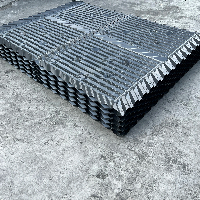
For example, crossflow towers commonly use larger fill modules designed around horizontal airflow through the fill pack.
If you are working on a crossflow tower, you can see our Crossflow Cooling Tower Fill for a typical replacement solution.
Fill Material
Material is another important point.
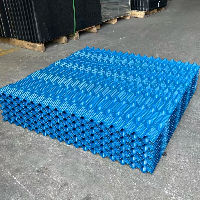
PVC Cooling Tower Fill is widely used for general industrial and HVAC cooling tower applications. It offers good processability, reasonable chemical resistance, and competitive cost.
For applications involving higher temperatures or more aggressive operating conditions, other materials such as CPVC or PP may be worth considering.
For general PVC applications, take a look at our PVC Cooling Tower Fill.
Fill Pitch
Pitch is another detail that is easy to overlook.
A smaller pitch can provide a larger effective contact area, but it may also be more sensitive to fouling and blockage. A larger pitch may be more suitable for water containing higher levels of suspended solids.
There is no single pitch that is perfect for every cooling tower.
The best choice depends on water quality, airflow, thermal requirements, and the original tower design.
Fill Dimensions
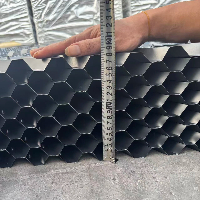
Measure the existing fill carefully before ordering replacement material.
Important dimensions may include:
- Fill sheet width
- Fill module length
- Fill pack height
- Pitch
- Sheet thickness
- Connection method
- Module arrangement
For replacement projects, it is also useful to take a few photos of the existing fill installation. A photo can often reveal information that measurements alone cannot.
Cleaning Old Fill vs. Replacing It
This is a question we hear quite often: Can I just clean the old fill?
Sometimes, yes.
If the fill is still structurally sound and the main problem is surface dirt or light scale, cleaning may restore part of the original performance.
But cleaning cannot repair cracked sheets, permanently deformed channels, missing sections, or material that has become brittle.
In those situations, continuing to clean the fill may only delay the inevitable.
A simple inspection can help:
- Dirty but structurally sound: consider cleaning first.
- Heavy scale or blockage: evaluate cleaning and water treatment.
- Cracked or brittle sheets: replacement is usually the better option.
- Deformed or collapsed fill: replacement should be considered.
- Repeated performance problems after cleaning: inspect the fill design and consider replacement.
How Much Efficiency Can You Gain From New Fill?
This is where you need to be careful with numbers.
Replacing old fill does not automatically mean that a cooling tower will suddenly achieve a specific percentage improvement in efficiency.
The actual result depends on many factors, including entering water temperature, leaving water temperature, wet-bulb temperature, water flow, air flow, fill condition, fill design, and the condition of the rest of the cooling tower.
In other words, new Cooling Fill can restore lost performance, but it cannot compensate for every problem in the tower.
If the fan is undersized, the water distribution system is blocked, or the airflow is seriously restricted, replacing the fill alone may not solve the entire problem.
A Practical Way to Evaluate an Old Cooling Tower
If you are planning a replacement project, we recommend starting with the basics rather than immediately choosing a product.
Step 1: Record the Current Operating Conditions
Record the entering water temperature, leaving water temperature, ambient wet-bulb temperature, water flow, and other available operating data.
This gives you a baseline for comparing the tower before and after replacement.
Step 2: Inspect the Existing Fill
Look for cracks, deformation, scale, dirt, biological growth, blocked passages, and broken modules.
Step 3: Measure the Existing Fill
Measure the dimensions and identify the pitch, material, and installation method.
Step 4: Check the Water Distribution System
Do not forget the nozzles and distribution pipes.
New fill will not perform properly if water is not distributed evenly across the fill surface.
Step 5: Select the Replacement Fill
Choose the tower fill based on tower type, water quality, temperature, airflow, dimensions, and required thermal performance.
Step 6: Compare Performance After Replacement
After installation, compare the operating data with the original baseline. This is a much better way to judge the effect of a fill replacement than simply looking at the new fill and assuming it is more efficient.
What About Film Fill for Older Cooling Towers?
Film fill is widely used because it creates a large contact surface between air and water in a relatively compact volume.
However, the right film fill cooling tower solution depends heavily on the application.
If the circulating water is relatively clean, a fine-pitch film fill can provide excellent heat transfer performance.
If the water contains a high level of suspended solids or the tower is difficult to maintain, a more open fill design may be more practical.
That is why we recommend looking at the complete operating condition instead of simply choosing the fill with the smallest pitch.
When Should You Replace Cooling Tower Fill?
There is no universal replacement interval that works for every cooling tower.
Some towers may require fill replacement after several years, while others can operate much longer depending on water quality, operating temperature, chemical treatment, UV exposure, cleaning practices, and mechanical damage.
Instead of replacing the fill simply because it has reached a certain age, inspect its actual condition and monitor cooling performance.
That gives you a much better maintenance decision.
One Simple Rule We Use for Fill Replacement
Here is the simple way to look at it:
If the fill is dirty, clean it. If the fill is damaged, replace it. If the tower is not cooling properly, find out why before changing components.
It sounds simple, but this approach can prevent a lot of unnecessary maintenance costs.
Need Help Selecting Cooling Tower Fill?
If you are replacing old cooling tower fill and are not sure which type to use, you do not necessarily need to send us a complicated specification sheet.
You can send us:
- A few photos of the existing fill
- Fill width and length
- Fill pitch, if known
- Cooling tower type
- Material, if known
- Approximate cooling tower size
- Operating temperature and water quality, if available
We can then help you check whether the existing fill can be replaced with a standard design or whether a customized cooling tower replacement fill would be more suitable.
For replacement projects, we can also support OEM dimensions and different materials according to the application.
View Cooling Tower Replacement Fill
Final Thoughts
When a cooling tower starts losing performance, it is easy to blame the fan, pump, or other mechanical equipment.
But the fill is where the actual air-water contact happens, so it deserves a closer look.
Replacing old, damaged, or badly fouled Cooling Tower Fill can be a practical way to restore cooling performance without replacing the entire tower.
The important part is not simply buying new fill. The important part is matching the new Cooling Tower Media to the tower design, water quality, airflow, operating conditions, and existing dimensions.
Have an old cooling tower fill that you need to replace? Send us the dimensions and a few photos. We can help you identify the fill type and prepare a replacement solution.