PVC, CPVC, and PP Cooling Tower Fill: Temperature and Chemical Resistance Comparison
PVC, CPVC, and PP Cooling Tower Fill: Temperature and Chemical Resistance Comparison
When a cooling tower needs new fill, the first question is usually not “Which fill has the best heat transfer?” It is often much simpler: Which material can actually survive the water temperature and chemical conditions in my tower?
PVC is still the most common choice for many cooling tower applications. But when operating conditions become more demanding, CPVC or PP can make more sense.
This is especially important when you are looking for cooling tower replacement fill. Choosing the wrong material may save a little money during the initial purchase, but it can lead to deformation, brittleness, cracking, or a much shorter service life later.
In this guide, we will compare PVC, CPVC, and PP Cooling Tower Fill from a practical engineering point of view, with a focus on temperature resistance, chemical resistance, and typical applications.
PVC vs. CPVC vs. PP Cooling Tower Fill at a Glance
| Material | Typical Strength | Temperature Resistance | Chemical Resistance | Typical Application |
|---|---|---|---|---|
| PVC | Good balance of cost and performance | Good for normal cooling tower conditions | Good | General industrial and HVAC cooling towers |
| CPVC | Better high-temperature performance | Higher than PVC | Very good | Hot water and more demanding industrial applications |
| PP | Excellent resistance to heat and many chemicals | High | Excellent for many aggressive environments | Industrial cooling systems and special applications |
These are general material comparisons. The actual performance of a film fill cooling tower also depends on water chemistry, operating temperature, sheet thickness, fill design, airflow, and how the fill is installed.
1. PVC Cooling Tower Fill: The Practical All-Rounder
PVC is probably the material you will see most often when dealing with standard Cooling Tower Media.
It offers a good combination of price, rigidity, chemical resistance, and manufacturing stability. For many normal cooling tower systems, there is simply no reason to use a more expensive material if PVC can handle the operating conditions.
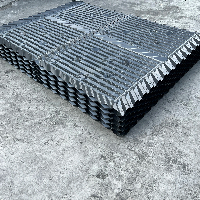
For example, PVC tower fill is commonly used in HVAC cooling towers, commercial buildings, industrial process cooling, and many standard counterflow and crossflow systems.
The main thing to watch is temperature. PVC works very well within its intended operating range, but continuous exposure to excessive hot water can gradually soften the material and affect the shape of the fill.
So if you are replacing an existing Corrugated Fill, don't just copy the old dimensions. Check the actual operating temperature first.
When PVC is usually a good choice
- Standard cooling tower water temperatures
- HVAC and commercial cooling systems
- General industrial cooling applications
- Normal water chemistry
- Projects where cost and performance both matter
If you are looking for a standard PVC replacement, you can see our PVC Cooling Tower Fill for more details.
2. CPVC Cooling Tower Fill: When Temperature Becomes the Problem
CPVC is chemically similar to PVC, but the additional chlorination changes its temperature performance and chemical resistance.
This is where CPVC becomes interesting for cooling tower applications.
If the water temperature is higher than what standard PVC can comfortably handle, CPVC can provide a safer operating margin. It is often considered when the cooling system operates under elevated temperature conditions or when the water chemistry is more demanding.
Of course, higher temperature resistance usually comes with a higher material cost. That means CPVC is not automatically “better” than PVC for every tower.
If the tower is operating under normal conditions, using CPVC simply because it has a higher temperature rating may not give you any meaningful advantage.
When CPVC may be worth considering
- Higher operating water temperatures
- Industrial process cooling
- More demanding chemical environments
- Applications where longer material life is more important than the lowest initial cost
In other words, think of CPVC as a material for when the cooling tower conditions are starting to push beyond what standard PVC can comfortably handle.
3. PP Cooling Tower Fill: A Strong Choice for Demanding Conditions
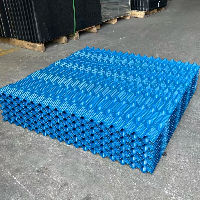
PP, or polypropylene, is another popular material for industrial Cooling Fill applications.
One of its biggest advantages is its resistance to heat and many chemicals. This makes PP particularly interesting when the cooling water contains substances that could be problematic for conventional PVC fill.
PP also has good resistance to many aggressive chemicals and can perform well in demanding industrial environments.
However, PP is not automatically the best choice for every cooling tower. Material selection still needs to consider the exact operating temperature, water chemistry, fill design, and mechanical requirements.
For example, if a tower operates under normal HVAC conditions, PVC may already provide everything you need. There is no reason to pay extra for PP if the application does not require it.
Where PP Cooling Tower Fill is commonly considered
- Industrial process cooling
- Higher-temperature cooling applications
- Chemically demanding environments
- Cooling systems where extended material durability is important
- Specialized cooling tower replacement projects
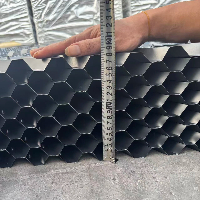
For counterflow applications, you can also check our PP Cooling Tower Packing for Counterflow Cooling Tower.
Temperature Resistance Is Not the Only Thing to Check
This is one point that is easy to overlook.
When engineers compare PVC, CPVC, and PP, temperature is usually the first specification they look at. But it should not be the only one.
The water chemistry inside the cooling tower can be just as important.
Check the Cooling Water Chemistry
Before choosing a Cooling Tower Fill material, look at the actual water conditions in the tower.
Depending on the application, you may need to consider:
- pH level
- Chlorine and oxidizing chemicals
- Biocides
- Acid or alkaline cleaning chemicals
- Oil or process contamination
- High mineral concentration
- Other chemicals entering the cooling water
A material that works perfectly in one cooling tower may not be the right choice for another tower operating in a completely different chemical environment.
What About Heat Transfer Performance?
There is another common misunderstanding when selecting Film Fill.
The material itself is important, but the material does not determine heat transfer performance by itself.
The design of the fill is also critical.
Pitch, sheet thickness, corrugation pattern, surface design, contact area, water distribution, airflow, and installation all affect how effectively the fill works.
That is why two products made from the same PVC material can still have very different performance characteristics.
For a film fill cooling tower, the goal is to create a large wetted surface area while allowing air and water to move through the fill with acceptable pressure drop.
How Do You Choose the Right Material?
If I were checking a cooling tower replacement project, I would not start with the material price.
I would start with three basic questions:
1. What is the actual operating temperature?
Do not rely only on the original equipment documentation. If possible, check the actual inlet and outlet water temperatures during operation.
2. What is in the cooling water?
Look at the water treatment program and chemical concentration. A normal HVAC tower and an industrial process tower can have very different water chemistry.
3. What material was used before?
If the original fill lasted for many years without material-related problems, replacing it with the same material may be the most practical solution.
But if the old fill became soft, warped, cracked, or brittle much earlier than expected, that is a reason to investigate the material selection before simply ordering the same thing again.
PVC, CPVC or PP: Which One Should You Choose?
There is no universal winner.
PVC is usually the practical choice for standard cooling tower conditions.
CPVC becomes more attractive when higher temperature resistance or improved chemical resistance is required.
PP is often considered for demanding industrial environments where heat and chemical resistance are especially important.
The best material is the one that matches the actual conditions of your tower—not simply the material with the highest temperature rating.
Choosing Cooling Tower Replacement Fill
If you are replacing old fill, material selection is only one part of the job.
You also need to confirm the original fill dimensions, width, length, pitch, angle, sheet thickness, block configuration, and connection method.
For some projects, the customer only has photos and the old fill dimensions. That's usually enough for us to start checking the replacement option.
We manufacture PVC, CPVC and PP film fill cooling tower products and can produce different sizes and configurations for replacement projects.
You can also check our PVC CPVC PP Film Fill Cooling Tower Packing for Counter Flow Cooling Tower OEM Manufacturer China to see the available material options and OEM capabilities.
One More Tip Before You Order
If you are not sure whether PVC, CPVC or PP is suitable for your tower, don't guess based only on the old product name.
Send us the following information:
- Cooling tower model or photos
- Existing fill dimensions
- Water inlet and outlet temperature
- Cooling water chemistry, if available
- Counterflow or crossflow configuration
- Required quantity
With these details, it is much easier to recommend the right Cooling Tower Media instead of simply selling the most expensive material.
Need Cooling Tower Fill for a Replacement Project?
We manufacture Cooling Tower Fill, Film Fill, Corrugated Fill and cooling tower replacement fill for industrial and commercial cooling tower applications.
We can supply PVC, CPVC and PP options and support OEM production according to your dimensions and requirements.
If you already have the old fill, simply send us the size and a few photos. We can check the suitable replacement configuration with you.
```